Worldwide Free Shipping — including India & Egypt100% Genuine Original Tranya Products
0%

Choosing a Blood Oxygen Tracker Smart Band is not simply about finding the brightest screen or the lowest price. Global buyers need dependable readings, comfortable materials, clear software, and support that works across regions. A band resting loosely on the wrist may show unstable values during a cold morning walk. Motion, darker skin pigmentation, poor circulation, and bright outdoor light can also influence optical measurements. Accuracy matters. Fit matters.

Professor John Allen, a biomedical engineer and pulse oximetry researcher, has emphasized, “Pulse oximetry is not a substitute for clinical assessment.” That warning should guide every comparison. These bands can help users observe patterns during sleep, exercise, or quiet recovery. They should not diagnose illness or replace professional medical advice. Look for transparent testing information, sensor specifications, app history, firmware updates, and clearly stated limitations. Independent reviews are useful, but laboratory evidence deserves greater weight.

The best models for international buyers may offer multilingual apps, broad smartphone compatibility, USB-C charging, and reliable warranty support. Battery life also matters when traveling across time zones. A comfortable strap can make overnight tracking more realistic, while waterproof protection supports daily routines. However, “water-resistant” does not always mean suitable for swimming. That distinction is easy to miss. Privacy policies deserve attention too, especially when health data travels through cloud services. No band is perfect, and advertised oxygen accuracy may look stronger than real-world performance. This guide compares practical strengths, weaknesses, and missing details, helping readers choose with informed caution rather than marketing excitement.
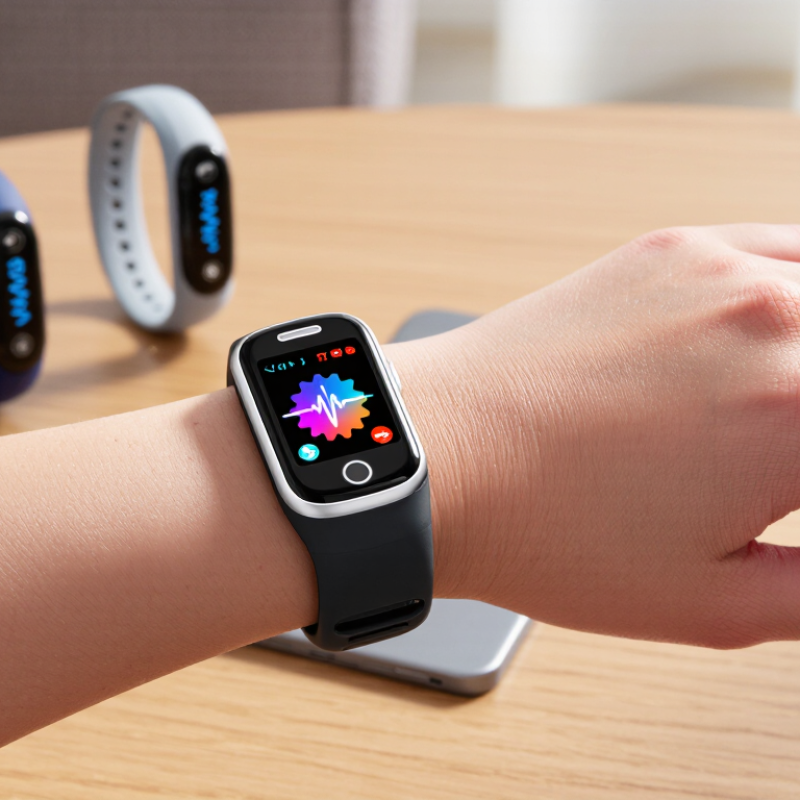
Top Blood Oxygen Tracker Smart Bands for Global Buyers

How Smart Bands Estimate Blood Oxygen with Red and Infrared Light

Top Blood Oxygen Tracker Smart Bands for Global Buyers

How Smart Bands Estimate Blood Oxygen with Red and Infrared Light

A smart band uses photoplethysmography, or PPG, to estimate blood oxygen saturation. Tiny LEDs shine red light near 660 nanometers and infrared light near 940 nanometers into the skin. Oxygenated and deoxygenated blood absorb these wavelengths differently. A sensor records the returning light, then software compares the changing absorption pattern during each heartbeat.

The result is an estimate, not a direct blood test. A secure fit matters. A loose band, cold fingers, dark room, sweat, or arm movement can distort the signal. The U.S. FDA’s 2021 safety communication warned that pulse oximeter readings may be less accurate under certain conditions, including skin pigmentation. That warning deserves attention. Bright numbers can still mislead.

A 2020 New England Journal of Medicine analysis found occult hypoxemia in 11.7% of Black patients, compared with 3.6% of white patients, despite similar pulse-oximeter readings. The study involved more than 10,000 paired measurements. Smart bands usually face even greater challenges because they sit on moving wrists, not still fingertips. Read twice.

For global buyers, useful bands should show measurement trends, signal quality, and clear limitations. Look for testing aligned with recognized pulse-oximetry standards, such as ISO 80601-2-61, when applicable. Treat a sudden low reading as a prompt to rest and recheck. Persistent or worrying results need professional medical assessment, not blind trust in a small screen.

SpO₂ Basics: Interpreting the Clinical 95–100% Normal Range

Top Blood Oxygen Tracker Smart Bands for Global Buyers

SpO₂ measures the percentage of blood hemoglobin carrying oxygen. For most healthy adults at sea level, clinical readings between 95% and 100% are generally considered normal. A smart band can display useful trends, but it does not replace a medical pulse oximeter or professional assessment. Readings may change after exercise, during sleep, or at higher elevations.

A result below 95% deserves attention, especially when it repeats. Sit quietly, warm your hands, and check again after several minutes. Tight straps, movement, sweat, dark nail coverings, and poor skin contact can distort results. A single low number can feel alarming, but it may be wrong. Persistent low readings, breathing difficulty, chest discomfort, confusion, or blue lips require prompt medical advice. Do not judge health from SpO₂ alone; symptoms and personal medical history matter. The normal range is helpful, not absolute.

Tips: Wear the band firmly, without squeezing the skin. Keep your arm still and level with your heart during a reading. Compare results at similar times each day, and record exercise, altitude, sleep, and symptoms. Check the band’s sensor fit and data settings before trusting a pattern. Consumer devices are convenient, yet their accuracy can vary between users. I would question any sudden change before drawing a strong conclusion.

Top Blood Oxygen Tracker Smart Bands for Global Buyers - SpO₂ Basics: Interpreting the Clinical 95–100% Normal Range

Tracker Type Best Use SpO₂ Measurement Pattern Clinical Reference Key Strengths Important Limitations Global-Buyer Checklist
Wrist-based smart band Wellness trends, sleep summaries, and occasional spot checks Usually uses optical sensors and may measure on demand or at scheduled intervals 95–100%: commonly considered normal at sea level for many healthy adults Lightweight, convenient, activity tracking, app-based history, broad international availability Wrist readings can be affected by movement, loose fit, cold skin, low circulation, tattoos, and skin-contact conditions; generally not a diagnostic device Check supported phone systems, app language, privacy terms, charging method, water-resistance rating, and regional availability
Continuous-monitoring smart band Longer-term trend observation during rest or sleep Collects periodic readings rather than guaranteeing a medical-grade continuous waveform 93–94%: repeat the reading while still and warm; consider medical advice if persistently low or symptomatic May reveal personal patterns and nighttime changes when measurements are taken consistently Sampling gaps, sleep movement, poor sensor contact, and algorithm differences can produce misleading isolated values Look for measurement-frequency controls, exportable data, clear timestamping, alert settings, and transparent accuracy information
Fitness-focused smart band Exercise and recovery context, not diagnosis May prioritize activity metrics and provide SpO₂ readings mainly during rest or selected workouts ≤92%: a low result should be rechecked correctly; urgent assessment may be appropriate depending on symptoms and medical guidance Useful combination of heart rate, steps, training load, and sleep-related data Motion and poor blood flow can reduce optical-sensor reliability during exercise; oxygen saturation naturally varies with altitude and health status Confirm whether SpO₂ works during exercise, whether readings can be taken manually, and whether alerts are available in the buyer’s region
Sleep-oriented smart band Overnight wellness trends and sleep-behavior review Often records intermittent overnight readings; results are trend indicators rather than a diagnosis of sleep disorders A single low nighttime value does not establish a medical condition; repeated patterns should be discussed with a qualified clinician Comfort-oriented design, sleep timeline, resting heart-rate context, and multi-night trend reports Fit changes during sleep, skin position, sensor movement, and incomplete data can affect results Prioritize comfort, adjustable fit, battery duration, overnight sampling details, data retention, and readable reports
Fingertip pulse oximeter Short, stationary spot checks when a more direct consumer measurement is needed Measures through the fingertip using red and infrared light; readings should be taken while still and relaxed The 95–100% range is a general reference at sea level; personal targets may differ with altitude or medical conditions Designed specifically for spot measurement and usually easier to position correctly than a moving wrist device Not continuous, may be affected by nail products, cold fingers, movement, poor circulation, and device quality; not a substitute for clinical evaluation Check regulatory markings applicable to the destination, instructions, display readability, battery type, and stated accuracy range
Clinical monitoring equipment Professional assessment, supervised monitoring, and medical decision-making Uses validated hardware, defined operating procedures, and trained interpretation within a clinical setting Interpretation depends on symptoms, baseline health, altitude, perfusion, and other clinical information—not SpO₂ alone Supports documented care pathways and professional review Higher cost, professional setup, and not intended primarily for casual consumer wellness tracking Verify local regulatory requirements, service support, calibration policy, training, and clinical-use documentation
Reading guidance: SpO₂ is the estimated percentage of hemoglobin carrying oxygen. For many healthy adults at sea level, 95–100% is a common reference range. Readings can differ because of altitude, circulation, skin temperature, movement, sensor fit, and device design. Recheck an unexpected result while seated, warm, still, and correctly fitted. Seek medical help for persistent low readings, concerning symptoms, or any value that conflicts with professional advice.

Accuracy Testing: Applying the ±3% Benchmark for 70–100% SpO₂

For global buyers, the ±3% benchmark deserves careful attention. The FDA’s 2013 pulse oximeter guidance uses an accuracy target of ±3 percentage points across 70–100% SpO₂. This range matters because readings below 90% can signal serious oxygen loss. However, smart bands are not automatically equivalent to clinical pulse oximeters. Their sensors face movement, loose contact, sweat, cold fingers, and darker environments.

A practical test should compare each band with a validated reference device. Take three readings after five minutes of rest, then repeat during gentle movement. Record the band’s value, the reference value, skin temperature, and contact position. A 96% band reading beside a 94% reference reading fits the ±3% limit. A 91% reading beside 95% does not. FDA’s 2021 safety communication also warned that skin pigmentation, poor circulation, and low temperature may affect pulse oximeter accuracy. The evidence is useful, but not perfect.

Tips: Test on warm, still skin. Keep the band snug, not tight. Ignore one unusual reading. Check repeated patterns. Buyers should also inspect published validation methods, sample size, and the tested SpO₂ range. Some product claims sound precise but omit these details. That omission should invite reflection, not confidence. A smart band can support trend tracking, yet it should not replace professional assessment when symptoms or persistent low readings appear.

Sensor Quality: Comparing Reflective PPG, Sampling Rates, and Motion Control

Reflective PPG estimates blood oxygen by shining light into the wrist and measuring returning signals. Sensor quality depends on light wavelength, detector sensitivity, and skin contact. The FDA warns that motion, poor circulation, skin temperature, and skin pigmentation can affect pulse-oximeter readings. Wearable bands face these problems more often than fingertip devices.

Sampling rate matters, but higher is not automatically better. A 25 Hz sensor captures faster waveform changes than a 10 Hz sensor, helping algorithms reject brief movement spikes. However, continuous sampling increases power use and may still produce unstable results. A 2023 review in Sensors reported that wearable oxygen estimates often showed larger errors during walking than during rest. That difference is practical, not theoretical.

Motion control should combine accelerometers, adaptive filtering, and repeated measurements. Look for bands that show signal-quality warnings, rather than presenting every number as medical fact. ISO 80601-2-61 emphasizes accuracy testing across oxygen levels, skin contact conditions, and motion scenarios. Yet many consumer reports use small samples and short tests. That limitation deserves attention.

In daily use, tighten the band gently, keep the sensor flat, and measure after sitting quietly for one minute. Compare trends, not isolated readings. I would distrust a perfect-looking result after exercise. The display may look precise. The measurement may not be.

Global Buying Standards: Checking FDA, CE, FCC, and ISO 80601-2-61 Claims

For global buyers, certification claims need careful separation.
FDA clearance means a device has met a defined regulatory pathway, not that every reading is clinically perfect.
CE marking indicates conformity with applicable European requirements, while FCC authorization mainly covers radio-frequency emissions. It does not prove oxygen accuracy. ISO 80601-2-61 is more relevant to pulse oximeter safety and performance, but buyers should confirm whether the band itself was tested under this standard. Some products display the standard without showing a matching test report.

Look for the exact model number, intended-use statement, manufacturer declaration, and independent laboratory results.

The FDA’s 2021 safety communication warned that pulse oximeter accuracy can vary with skin pigmentation and poor circulation. A New England Journal of Medicine study found occult hypoxemia in 11.7% of Black patients, compared with 3.6% of white patients, under similar pulse-oximeter readings (Sjoding et al., 2020).

That finding matters when a band promises dependable home monitoring. Real-world motion, cold fingers, loose straps, and weak signals can also distort results.

A polished certificate is not enough. I would compare readings with a clinically validated reference device and question vague “medical-grade” language. The uncomfortable point remains: even compliant hardware can produce uncertain data in everyday conditions.

FAQS

What does the ±3% SpO₂ accuracy benchmark mean?

It applies across readings from 70% to 100% SpO₂. A 96% band reading and 94% reference reading fit the limit. A 91% reading beside 95% does not. This benchmark is useful, but not a promise of perfect results.

How should buyers test a smart band’s oxygen readings?

Rest quietly for five minutes before testing. Take three readings with a validated reference device. Repeat the test during gentle movement. Record readings, skin temperature, and contact position. Small studies can still miss real-world problems.

Which conditions can distort wrist oxygen readings?

Movement, loose contact, sweat, cold skin, and poor circulation can interfere. Darker environments may weaken the returning light signal. Skin pigmentation can also affect accuracy. Warm, still skin usually gives a better test.

Is a higher sensor sampling rate always better?

No. A 25 Hz sensor captures more waveform changes than a 10 Hz sensor. It may help reject brief movement spikes. Continuous sampling can increase power use and remain unstable. More data does not guarantee better data.

What sensor features should buyers inspect?

Look for reflective light sensors, motion filtering, and repeated measurements. An accelerometer can help identify walking or sudden movement. Signal-quality warnings are valuable. A precise-looking number may still be weak evidence.

How should I wear the band during measurement?

Keep the sensor flat against warm skin. Make the strap snug, but not tight. Sit quietly for one minute before measuring. Check the same wrist position each time. Comfort matters more than squeezing.

Do regulatory and technical certificates prove oxygen accuracy?

Not necessarily. Regulatory clearance shows a defined review pathway. Radio authorization mainly addresses wireless emissions. A relevant performance standard is more useful for oxygen testing. Ask for the exact model, intended use, test report, and sample size. A certificate alone is not enough.

Should one unusual reading cause concern?

Do not rely on one isolated result. Repeat the test after resting and warming the skin. Watch for repeated low readings and related symptoms. A smart band can track trends, not replace professional assessment. I might trust a pattern too quickly. That deserves caution.

Conclusion

A Blood Oxygen Tracker Smart Band estimates blood oxygen saturation (SpO₂) by shining red and infrared light into the skin and analyzing how much light is absorbed by blood. Most devices use reflective PPG sensors, which continuously collect optical data from the wrist. Sampling speed, sensor design, secure skin contact, and motion-control algorithms all influence measurement stability. Because wrist-based readings can be affected by movement, temperature, circulation, and fit, users should view them as wellness information rather than a replacement for clinical testing.

When reviewing results, the commonly referenced clinical range of 95–100% is generally considered normal for many healthy adults, although individual conditions may vary. A practical accuracy benchmark is approximately ±3% across the 70–100% SpO₂ range, supported by transparent testing information. Global buyers should also examine compliance claims carefully, including applicable FDA or CE pathways, FCC requirements for wireless functions, and references to ISO 80601-2-61. Clear documentation, responsible warnings, and consistent performance matter more than appearance alone.


Clara

Clara

Clara is a dedicated marketing professional with a strong understanding of the company’s products, services, and customers. Her work combines market insight, clear communication, and a practical understanding of how businesses can use reliable solutions to improve efficiency, strengthen customer......