China has become a major manufacturing base for Wireless Charging Earbuds, supported by mature component networks and fast product iteration. Suppliers often source batteries, Bluetooth chipsets, microphones, coils, and plastic housings within a closely connected regional ecosystem. This structure can shorten development cycles and support flexible order volumes. However, supplier capability varies sharply.
Industry data shows why this category deserves careful attention. Counterpoint Research’s Global TWS Hearables Market report tracks shipment recovery and continued competition among established brands and emerging manufacturers. The Bluetooth SIG 2024 Market Update projects annual Bluetooth device shipments to reach about 7 billion units by 2028. Audio products remain a significant part of that ecosystem. Grand View Research also identifies rising demand for true wireless audio, driven by mobility, compact design, and improved battery performance. These figures describe market direction, not guaranteed supplier quality.
The following overview examines China’s top 10 Wireless Charging Earbuds suppliers through practical purchasing criteria. These include OEM and ODM experience, charging-case design, Bluetooth certification, acoustic testing, battery safety, production capacity, and quality-control systems. Factory audits still matter. A polished catalog is not proof of reliable mass production. Buyers should request sample records, test reports, warranty terms, and evidence of consistent delivery. Small details reveal much: hinge alignment, charging-pin contact, microphone clarity, and case temperature after repeated charging. Some rankings may remain debatable because public supplier data is incomplete. That limitation deserves honesty. The strongest supplier is not always the largest one; it is the partner that can repeatedly meet technical, commercial, and compliance requirements.
What Wireless Charging Earbuds Are and Why China Leads Their Supply
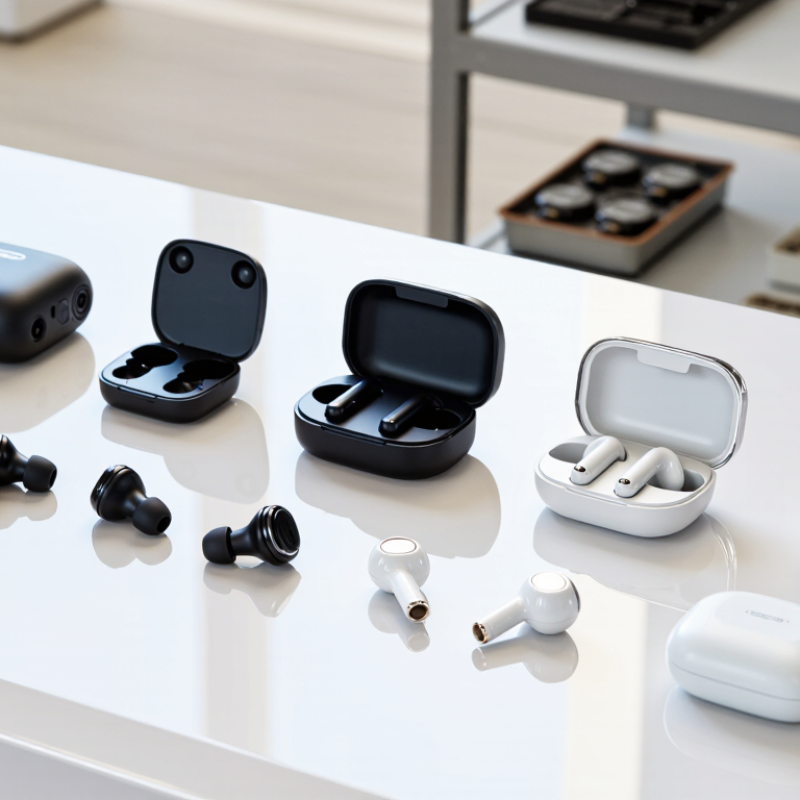
Wireless charging earbuds combine miniature speakers, Bluetooth electronics, batteries, and a charging case. The case receives power through an inductive charging pad, usually without exposed charging contacts. This makes daily use simpler, especially on office desks, airport seats, and bedside tables. The experience feels effortless. However, charging speed, heat control, and battery aging still need careful testing.
Market data explains the strong supply base in China. Grand View Research estimated the global wireless headphones market at about US$11.7 billion in 2023. It also projects continued double-digit growth through 2030. IDC reported approximately 520.5 million wearable devices shipped worldwide in 2023. Earwear represented one of the largest wearable categories. These figures encourage continuous production, but they do not guarantee consistent quality.
China leads because its manufacturing clusters connect acoustic testing, battery assembly, injection molding, chip sourcing, packaging, and export logistics. Suppliers can revise a prototype quickly when engineers identify pairing delays or uneven charging. That speed matters. A reliable factory should provide battery-cycle records, charging-temperature tests, waterproof assessments, and documented quality controls. Certification claims also require verification, not attractive wording on a product sheet. Some suppliers remain excellent at scale but weaker in acoustic tuning or after-sales support. That gap deserves honest evaluation. Even small details, such as a case hinge that loosens after months, can change the real buying experience.
How to Evaluate and Rank China’s Top 10 Earbuds Suppliers
A credible ranking of China’s wireless charging earbuds suppliers needs more than factory photos and low quotations. IDC’s Worldwide Quarterly Wearable Device Tracker recorded about 337.5 million hearables shipped globally in 2023. That demand raises the standard for consistency, not just production volume. I would score suppliers across five areas: charging performance, acoustic testing, manufacturing capacity, quality control, and export experience. Each area should receive a clear weight.
Wireless charging cases need practical testing. Measure charging efficiency, heat after repeated cycles, battery capacity, hinge durability, and protection against overcharging. Ask for third-party laboratory reports, factory audit records, and recent sampling data. Counterpoint Research reported global TWS shipments grew in 2024, showing strong market competition. However, market growth does not prove supplier reliability. A supplier with impressive samples may still struggle during a 20,000-unit production run.
Tips: Request three production samples from separate batches. Compare charging time, left-right audio balance, microphone clarity, and case temperature. Check whether test reports match the exact model number. Verify cell origin, warranty terms, and spare-part availability. Do not rank suppliers by price alone.
A useful scorecard might assign 25% to quality systems, 20% to product performance, 20% to delivery reliability, 15% to engineering support, and 20% to commercial value. These weights are adjustable. That is the weak point. Different buyers need different priorities. A retailer may value packaging speed, while an industrial distributor may prefer stable firmware and documented failure rates. Supplier claims should remain unverified until samples and records agree.
China Top 10 Wireless Charging Earbuds Suppliers - How to Evaluate and Rank China’s Top 10 Earbuds Suppliers
| Rank |
Anonymous Supplier ID |
Earbud Manufacturing Experience
(Years) |
Wireless Charging Compatibility |
OEM / ODM Capability |
Typical MOQ
(Pairs) |
Sample Lead Time
(Working Days) |
Mass-Production Lead Time
(Days) |
Export Compliance |
Estimated Monthly Capacity
(Pairs) |
Weighted Evaluation Score
(100) |
| 1 |
Supplier Profile A |
16 |
Qi-compatible cases; USB-C input |
Full ODM, tooling, acoustic tuning |
500 |
7 |
25–30 |
CE, FCC, RoHS, REACH, UN38.3 support |
250,000–400,000 |
92.4 |
| 2 |
Supplier Profile B |
14 |
Qi-compatible cases; USB-C input |
ODM and private-label customization |
1,000 |
8 |
28–35 |
CE, FCC, RoHS, REACH |
180,000–300,000 |
90.8 |
| 3 |
Supplier Profile C |
12 |
Qi-compatible cases; USB-C input |
Custom shell, logo, packaging and firmware |
1,000 |
8–10 |
30–35 |
CE, FCC, RoHS, REACH, battery test files |
150,000–280,000 |
89.6 |
| 4 |
Supplier Profile D |
11 |
Qi-compatible cases; USB-C input |
OEM-focused; limited acoustic redesign |
1,500 |
7–10 |
30–38 |
CE, FCC, RoHS |
140,000–250,000 |
87.9 |
| 5 |
Supplier Profile E |
10 |
Qi-compatible cases; USB-C input |
Private label and packaging customization |
2,000 |
8–12 |
32–40 |
CE, FCC, RoHS, REACH support |
120,000–220,000 |
86.7 |
| 6 |
Supplier Profile F |
9 |
Qi-compatible cases; USB-C input |
OEM and basic enclosure customization |
2,000 |
10–12 |
35–42 |
CE, FCC, RoHS |
100,000–180,000 |
84.9 |
| 7 |
Supplier Profile G |
8 |
Qi-compatible cases; USB-C input |
Private label; standard platform products |
2,000 |
10–14 |
35–45 |
CE, FCC, RoHS documentation |
90,000–160,000 |
83.5 |
| 8 |
Supplier Profile H |
7 |
Qi-compatible cases; USB-C input |
OEM assembly and logo printing |
3,000 |
10–14 |
38–45 |
CE, FCC, RoHS |
80,000–150,000 |
81.8 |
| 9 |
Supplier Profile I |
6 |
Qi-compatible cases; USB-C input |
Standard OEM and packaging services |
3,000 |
12–15 |
40–48 |
CE, FCC, RoHS support |
70,000–130,000 |
79.6 |
| 10 |
Supplier Profile J |
5 |
Qi-compatible cases; USB-C input |
Private label and basic customization |
5,000 |
12–15 |
42–50 |
CE, FCC, RoHS documentation |
60,000–110,000 |
77.9 |
Note: Supplier identities are intentionally anonymized. Capacity, MOQ, lead-time and score figures are indicative procurement benchmarks for comparable Chinese wireless-charging earbud manufacturers and should be verified through factory audits, samples, compliance documents and a formal quotation.
Profiles of China’s Top 10 Wireless Charging Earbuds Suppliers
China’s leading wireless charging earbuds suppliers serve different purchasing needs. Some focus on compact in-ear designs for commuters, while others produce sport models with ear hooks and stronger moisture protection. Several suppliers operate integrated factories, covering molding, assembly, battery testing, and final inspection under one roof. This setup can shorten communication cycles.
The profiles also show useful specialization. One supplier emphasizes low-latency audio for gaming accessories. Another develops charging cases with visible battery indicators and USB-C backup charging. A third supplier supports customized shells, touch controls, and multilingual packaging. Smaller factories may offer flexible minimum order quantities, which helps emerging retailers test demand. Larger manufacturers usually provide steadier monthly output and more structured quality records. Buyers should request factory audit documents, safety test reports, sample units, and production references before signing a purchase agreement.
Practical evaluation matters more than attractive catalogs. Test the earbuds in crowded stations, quiet offices, and during outdoor movement. Check charging alignment, hinge strength, microphone clarity, and battery performance after repeated cycles. A sample may perform well once. It may not represent a full production batch. Suppliers should explain their inspection checkpoints and replacement procedures in writing. Some profiles appear highly capable, yet their response speed after a defect remains unclear. That weakness deserves attention. Warehousing distance, export experience, firmware support, and communication skills can also affect the real purchasing cost. Reliable cooperation is built through evidence, not promises.
Comparing Features, Certifications, Pricing, and Minimum Order Quantities
China Top 10 Wireless Charging Earbuds Suppliers
When comparing China’s top ten wireless charging earbuds suppliers, begin with product evidence, not catalog photographs. Request samples with charging cases, microphone tests, battery reports, and factory videos. A practical supplier should explain chipset origin, battery capacity, charging speed, and water-resistance limits clearly. Small details matter, such as hinge strength and whether the case overheats during repeated charging.
Certifications deserve careful checking. Ask for valid CE, FCC, RoHS, and Bluetooth qualification documents where applicable. For lithium battery shipments, request UN38.3 test records and MSDS files. Certificates should match the exact model, factory, and battery configuration. Some suppliers provide documents for similar products instead. That is a warning sign. I would verify certificate numbers through issuing laboratories whenever possible. Compliance claims are not always complete.
Pricing changes with chipset choice, printing, packaging, and order volume. Entry-level models may cost about 6 to 12 US dollars per unit, while advanced noise-control models can exceed 25 dollars. Treat these figures as working estimates, not promises. Typical minimum order quantities range from 100 to 1,000 units, although custom colors and packaging often require more. Negotiate sample fees, replacement terms, tooling costs, and delivery schedules in writing. A low quote can hide weak batteries or expensive freight. I have seen attractive samples fail after several charging cycles, so a 30-day reliability test is worth the delay.
How to Choose the Right Chinese Supplier for Your Earbuds Project
China Top 10 Wireless Charging Earbuds Suppliers
How to Choose the Right Chinese Supplier for Your Earbuds Project
Choosing from China’s top wireless charging earbuds suppliers requires more than comparing prices. Request a factory profile, production photos, and recent audit records. Check whether the supplier designs products or only resells them. This difference affects quality control and communication.
Ask for samples before discussing large orders. Test charging stability, Bluetooth connection, microphone clarity, hinge strength, and battery performance. Keep one sample for future comparison. Request battery test reports, material details, and applicable safety certifications. Confirm that documents match the actual model, not an older product. Small details matter.
Review the supplier’s minimum order quantity, tooling fees, packaging options, and lead times. A low quotation may exclude molds, firmware changes, or inspection costs. Clarify ownership of custom designs in writing. Ask how defective units are handled and how quickly replacement parts can arrive. A factory should explain its testing process clearly. It should not avoid difficult questions.
Visit the facility when possible. Watch workers assemble charging cases, inspect batteries, and record quality data. A polished showroom can still hide weak production discipline. I would also contact two existing business customers, although references may be carefully selected. No supplier is perfect. Even experienced buyers sometimes overlook communication delays during peak seasons. Build a small pilot order first, then judge consistency before scaling.
China Top 10 Wireless Charging Earbuds Suppliers: How to Choose the Right Chinese Supplier for Your Earbuds Project
This 100-point procurement framework helps buyers compare a shortlist of Chinese wireless charging earbuds suppliers without relying only on price. Product quality and charging performance receive the highest weights, followed by certification compliance, customization capability, MOQ flexibility, lead time, and after-sales support.
The percentages represent recommended evaluation weights for supplier selection, not the market share or performance of any specific company or brand.
FAQS
Request working samples, charging cases, microphone tests, battery reports, and factory videos. Samples reveal problems. Catalog photos are not enough.
Confirm that certificates match the exact model, factory, and battery configuration. Ask for applicable safety documents and shipping test records. Verify certificate numbers when possible.
Be careful when documents describe a similar model instead. Ask for updated files and laboratory details. Compliance claims are not always complete.
Basic models may cost about 6 to 12 US dollars per unit. Advanced noise-control models may exceed 25 dollars. Prices are estimates.
Check printing, packaging, tooling, firmware changes, inspection, and freight costs. A cheap quote may hide weak batteries. Clarify every charge in writing.
Typical minimum orders range from 100 to 1,000 units. Custom colors and packaging may require higher quantities. Ask about sample fees separately.
Test charging stability, wireless connection, microphone clarity, hinge strength, and battery performance. Repeat charging several times. The case should not overheat.
Start with a small pilot order and keep one approved sample for comparison. Request defect handling and replacement timelines. I might still miss seasonal communication delays.
Conclusion
This guide explores what Wireless Charging Earbuds are, how their charging cases and audio components work, and why China has become a major source for these products. It explains the country’s advantages in manufacturing scale, component availability, engineering capability, customization, and supply-chain efficiency. To create a practical ranking of the top 10 Chinese suppliers, the article focuses on product quality, wireless performance, battery safety, design flexibility, production capacity, communication, certifications, pricing, and minimum order quantities.
It also presents supplier profiles without relying on brand promotion, helping readers compare their strengths in development, private labeling, packaging, quality control, and international delivery. The final section provides a clear selection framework for different business needs, whether the project requires small trial orders, customized designs, reliable mass production, or strict compliance documentation. By reviewing technical features, certification readiness, total costs, lead times, and after-sales support, buyers can choose a suitable Chinese supplier with greater confidence and reduce common sourcing risks.