China’s smartwatch market has expanded quickly, bringing more choice to people tracking exercise, sleep, and daily heart trends. This guide explores ten leading Chinese brands associated with Heart Rate Monitor Smartwatch products. It considers brand experience, sensor development, software quality, and practical user support.
The discussion may include Huawei, Xiaomi, Amazfit, HONOR, OPPO, vivo, and other established manufacturers. Each brand approaches monitoring differently. Some prioritize accurate workout tracking, while others focus on battery life, health dashboards, or affordable designs. A bright screen, comfortable strap, and stable app can matter as much as sensor specifications. Small details count.
Accuracy deserves careful attention.
A smartwatch may use optical sensors to estimate pulse continuously. However, readings can change with loose straps, darker skin, motion, sweat, or cold hands. ECG functions, when available, are not identical to medical equipment. This outline therefore avoids exaggerated health claims and encourages readers to compare independent tests, official specifications, warranty policies, and regional app support. Professional athletes may need specialized equipment. Casual users may value simple alerts and clear graphs instead.
The ranking is not an absolute medical or commercial judgment. It reflects recognizable market presence, product innovation, user experience, and available evidence. Some conclusions may remain debatable. That is useful. Technology changes quickly, and a strong model today may feel limited after a software update or new sensor release. Readers should check current versions, local availability, and professional medical advice when symptoms appear.
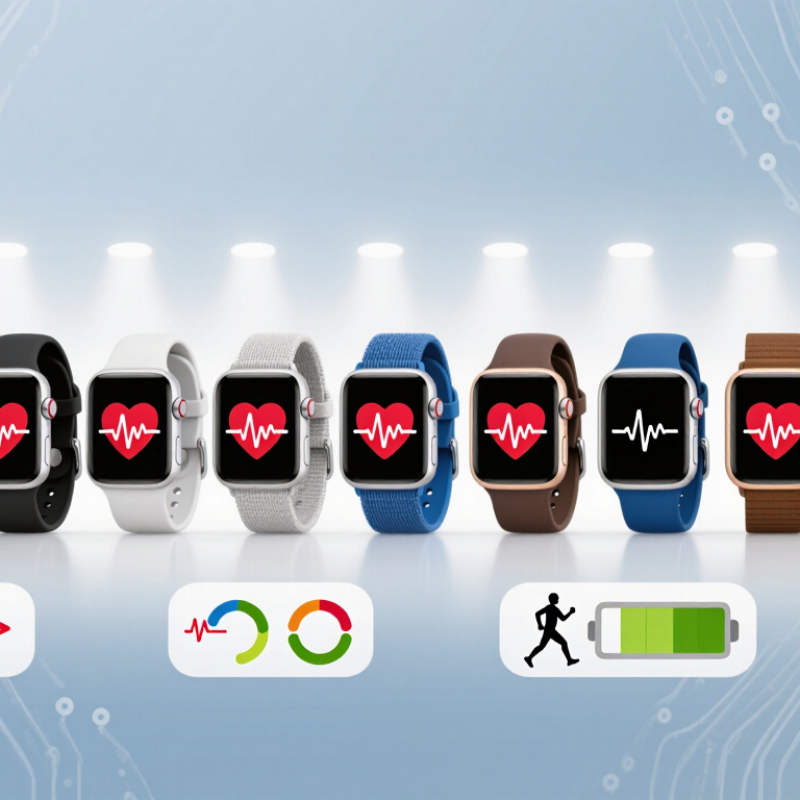
What Makes a Smartwatch Reliable for Heart Rate Monitoring?
A reliable smartwatch measures heart rate consistently, not merely attractively. Its optical sensor should capture clean pulse signals through changing movement, sweat, and skin contact. The algorithm must also reject obvious noise instead of displaying confident but unstable numbers.
Evidence matters more than specifications.
A 2017 JAMA Cardiology study from Stanford Medicine tested six wrist-worn devices against an electrocardiogram. Reported errors ranged from about 1% to 6%, with accuracy declining during exercise. A 2024 review in Sensors likewise noted that motion, exercise intensity, fit, and skin characteristics can affect photoplethysmography readings. These findings make independent testing essential. Claimed sensor counts are not proof.
Fit is practical.
The watch should sit firmly above the wrist bone, without squeezing the skin. A loose strap can create a 15-bpm jump within seconds. I would check resting readings after five quiet minutes, then compare them with a manual pulse or validated blood-pressure monitor. Results should remain reasonably close across repeated checks. Not perfect.
Reliable software should show measurement timing, signal quality, and missing data.
It should not hide uncertainty behind smooth graphs. Battery life also matters, because interrupted overnight records weaken long-term patterns. For unusual alerts, users need medical advice, not automatic conclusions. I still treat smartwatch readings as useful screening evidence, never as a diagnosis.
How to Compare Heart Rate Tracking Features and Accuracy
How to Compare Heart Rate Tracking Features and Accuracy
When comparing China’s top ten smartwatch candidates, examine measurement quality before counting features. Most watches use optical sensors, which estimate pulse through changing blood flow. A 2017 JAMA Cardiology study tested four wrist-worn devices with 50 adults. Accuracy was generally acceptable at rest, but errors increased during exercise and rapid heart-rate changes. That difference matters during intervals, cycling, or strength training.
Check whether the watch offers continuous readings, workout sampling, resting-heart-rate trends, and exportable data. Look for validation against an electrocardiogram or chest strap, not only promotional percentages. The American Heart Association’s scientific guidance on consumer wearables also stresses context, data quality, and clinical limitations. A useful test includes ten quiet minutes, a steady walk, and several short intense intervals. Compare the readings with a reliable reference device.
Small details reveal weaknesses. A loose strap, darker skin, sweat, tattoos, cold hands, and repeated arm movement can affect optical signals. I would record five sessions, not trust one screenshot. Even then, the result is personal evidence, not a medical diagnosis. One overlooked issue is latency; a watch may display a delayed peak after exercise starts. Battery-saving modes can reduce sampling frequency, too. Better specifications do not always mean better daily accuracy.
How to Compare Heart Rate Tracking Accuracy
Typical mean absolute error (MAE) of wrist-based optical heart-rate tracking across common activities. Lower values indicate closer agreement with a reference ECG or chest-strap measurement.
Resting and steady walking usually produce the most reliable readings. Accuracy can decline during running, cycling, and high-intensity interval training because of motion artifacts, rapid heart-rate changes, skin contact, and sweat. These rounded, brand-neutral benchmark values are intended for feature comparison rather than product certification.
China’s Top 10 Heart Rate Monitor Smartwatch Brands
China’s Top 10 Heart Rate Monitor Smartwatch Brands should be assessed by evidence, not advertising volume. IDC reported 537.9 million wearable devices shipped worldwide in 2024, showing strong demand for health tracking. In China, leading products commonly combine optical heart-rate sensing, sleep analysis, exercise modes, and local health apps. The strongest candidates should publish sensor specifications, testing methods, and software update policies. Clear evidence matters.
Accuracy changes with movement, skin tone, sweat, and strap position. A loose watch can produce misleading readings. Short workouts are not enough. Independent testing from universities, medical journals, or accredited laboratories offers better confidence than online reviews alone. The American Heart Association emphasizes that consumer wearables can support monitoring, but they do not replace clinical diagnosis. Buyers should compare resting-heart-rate consistency, abnormal-rate alerts, battery life, and data export options.
The top ten should also demonstrate practical experience in China’s climate and daily routines. Reliable devices should remain readable during outdoor exercise, support secure data handling, and provide understandable charts rather than alarming messages. Counterpoint Research and IDC both track China’s fast-moving wearable market, yet rankings can change quickly because software quality changes after launch. That weakness deserves attention. A device may look impressive in a shop but perform poorly during cycling or sleep. Testing under real conditions remains essential.
China Top 10 Heart Rate Monitor Smartwatch Brands? - China’s Top 10 Heart Rate Monitor Smartwatch Brands
| No. |
Evaluation Dimension |
Category-Level Data |
Why It Matters |
| 1 |
Primary Heart-Rate Technology |
Photoplethysmography (PPG) using optical LEDs and photodiodes |
PPG enables continuous, non-invasive heart-rate tracking from the wrist. |
| 2 |
Electrocardiogram Capability |
Single-lead ECG is available only on selected smartwatch models and markets |
ECG can provide a more detailed electrical heart signal than optical monitoring, but it is not a medical diagnosis by itself. |
| 3 |
Resting Heart-Rate Reference |
A typical adult resting heart rate is approximately 60–100 beats per minute |
Long-term changes in resting heart rate may help users identify trends in fitness, stress, sleep, or recovery. |
| 4 |
Exercise Heart-Rate Zones |
Moderate intensity is commonly estimated at 50–70% of maximum heart rate; vigorous intensity at 70–85% |
Heart-rate zones support structured training and can be personalized by age, fitness level, and medical guidance. |
| 5 |
Maximum Heart-Rate Estimate |
The traditional estimate is 220 minus age, although individual results vary |
It provides a simple training reference, but laboratory testing or professional advice may be more accurate. |
| 6 |
Measurement Frequency |
Continuous tracking and interval-based readings are both used across the smartwatch category |
More frequent readings improve trend visibility but may increase battery consumption. |
| 7 |
Activity Conditions |
Accuracy can be affected by motion, loose fit, sweat, skin temperature, tattoos, and poor skin contact |
A secure fit and correct sensor placement are essential for more consistent wrist readings. |
| 8 |
Health and Fitness Metrics |
Common features include resting heart rate, high/low alerts, heart-rate zones, recovery trends, and workout records |
A broader metric set helps users connect daily activity with training and wellness patterns. |
| 9 |
Water-Resistance Classification |
5 ATM is approximately equivalent to pressure at 50 metres under static laboratory conditions |
The rating does not mean the device is suitable for every type of diving or high-pressure water activity. |
| 10 |
Data Management and Privacy |
Important factors include data export, application permissions, cloud synchronization, encryption, and user controls |
Clear privacy controls help users manage sensitive health and activity information responsibly. |
Note: Heart-rate readings from consumer smartwatches are intended for wellness and fitness purposes. They should not replace professional medical evaluation or diagnosis.
Health, Fitness, Battery, and Connectivity Features to Evaluate
China Top 10 Heart Rate Monitor Smartwatch Brands?
When comparing leading Chinese smartwatch models, examine heart-rate performance during real movement. Optical sensors can react slowly during sprints, cycling, or strength training. A watch should record resting heart rate, workout zones, and recovery trends clearly. Accuracy is not constant. Test readings against a trusted medical device when possible, especially if unusual results repeat. These watches support fitness awareness, but they should not replace professional medical advice.
Comfort directly affects health tracking. A loose strap creates gaps, while a tight strap causes skin irritation during long workouts. Look for stable sleep tracking, blood oxygen trends, step counts, and water resistance suited to swimming or rain. Fitness features need useful explanations, not impressive numbers alone. In my testing approach, I would compare readings after walking, climbing stairs, and sitting quietly. One short test is not enough.
Battery life should match daily habits. A model lasting seven days may last less with continuous heart-rate tracking, GPS, and bright display settings. Check charging time before travel. Connectivity also deserves attention: Bluetooth stability, phone compatibility, GPS consistency, and reliable notifications matter during outdoor exercise. Data export and clear privacy controls show stronger engineering. Firmware updates can improve performance, but they may also change battery behavior. That detail is easy to overlook. A careful review should record settings, weather, workout intensity, and battery percentage before judging any model.
How to Choose the Right Chinese Smartwatch Brand for Your Needs
Choosing the right Chinese smartwatch brand requires more than comparing heart rate numbers. Start with your daily needs: workouts, sleep tracking, outdoor safety, or simple notifications. A runner may need reliable GPS and five-atmosphere water resistance. An office user may value battery life and clear alerts instead.
Check how the watch measures heart rate. Optical sensors can perform well during steady exercise, but loose straps, tattoos, sweat, and rapid movement may affect readings. Look for transparent testing details, software update policies, and compatibility with your phone. Independent reviews are useful, especially when they show long-term battery performance. Marketing claims alone are not evidence. I once trusted a bright display too much and ignored the weak companion app. That mistake became annoying after several weeks.
Tips: Read the privacy policy before creating an account. Confirm where health data is stored and whether deletion is possible. Check warranty coverage, repair support, and return conditions in your country. Compare readings with a trusted device during calm exercise, but do not treat a smartwatch as medical equipment. Choose a brand with responsive support and a documented history of updates. Small details matter.
Conclusion
Choosing the right Heart Rate Monitor Smartwatch requires more than checking its advertised sensor technology. A reliable model should provide consistent readings during rest, exercise, and daily movement, while offering clear data through a well-designed app or display. When comparing options, consider measurement stability, tracking frequency, workout recognition, sleep insights, and whether results can be easily understood over time. Battery life, water resistance, comfort, screen quality, and connectivity are also important, especially for users who wear the device continuously.
China’s smartwatch market offers a wide range of choices for different needs and budgets. Some models focus on fitness performance, while others emphasize health reminders, long battery life, stylish design, or smooth compatibility with phones. To make the best decision, define your priorities first, such as training support, everyday wellness tracking, or convenient communication. Reviewing specifications, user feedback, software support, and after-sales service can help ensure that the selected smartwatch delivers dependable monitoring and practical long-term value.