Worldwide Free Shipping — including India & Egypt100% Genuine Original Tranya Products
0%

Choosing the right Waterproof Wireless Earbuds for wholesale is more demanding than comparing prices and colorful product photos. Buyers must examine durability, sound performance, battery stability, comfort, and supplier consistency. A low unit cost means little if charging cases fail after several weeks.

Dr. Sean Olive, a respected headphone researcher, has said, “The fit is probably the most important factor in the sound of a headphone.” His observation matters for wholesale buyers. Earbuds that fit securely usually deliver stronger bass, clearer calls, and better passive noise isolation. They also reduce returns caused by discomfort or poor audio expectations.

This guide reviews ten Waterproof Wireless Earbuds models through a practical purchasing lens. We consider water-resistance ratings, Bluetooth reliability, microphone quality, charging speed, warranty support, and packaging readiness. Small details matter. A loose case hinge can damage the buyer’s trust. A confusing indicator light can increase customer complaints.

Real-world use is rarely perfect. Some earbuds perform well during gym sessions but struggle in heavy rain. Others advertise impressive battery life, yet actual results change with volume and call usage. That difference deserves attention.

The recommendations are not based on specifications alone. They reflect features that wholesale buyers can explain, test, and support. We also recognize an uncomfortable truth: no single model suits every market. Sports retailers, travel stores, and electronics distributors may need different priorities. Careful sampling remains essential before placing a large order.
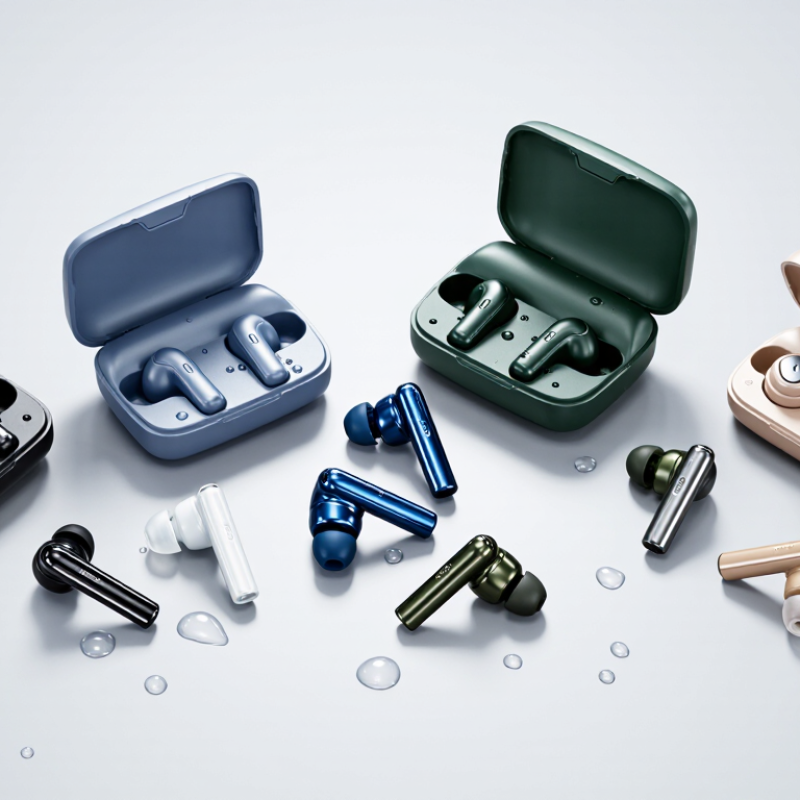
10 Best Waterproof Wireless Earbuds for Wholesale Buyers?

What Waterproof Ratings Mean for Wireless Earbuds

For wholesale buyers, waterproof ratings are more useful than the word “waterproof.” The IP code follows IEC 60529, the international protection standard. In IPX4, “X” means dust protection was not rated, while “4” indicates resistance to water splashes. IPX5 withstands water jets, and IPX7 covers temporary immersion up to one metre under controlled testing. IPX8 allows deeper or longer immersion, but the manufacturer must state the exact conditions.

This difference matters on a warehouse order sheet. IPX4 suits commuting and light gym sweat. IPX5 or IPX6 is safer for runners facing heavy rain. IPX7 may protect against a brief sink drop, but it does not guarantee survival in saltwater, chlorinated pools, soap, or hot showers.

Testing uses fresh water and fixed laboratory conditions. Real life is less polite. According to Canalys’ 2024 TWS market analysis, purchase decisions increasingly reflect practical features, including durability and battery performance. That trend supports clearer rating labels, not vague marketing claims.

Tips: Request the full IP test report, not only a product image. Confirm whether the charging case has its own rating. Earbuds may be IPX7 while the case is not water-resistant. Ask for ingress-test conditions and warranty exclusions. I would also test sample units after sweat exposure and repeated charging. A higher rating sounds better, but it can still hide weak hinges, microphones, or charging contacts.

Key Features Wholesale Buyers Should Compare

For wholesale buyers, the 10 best waterproof wireless earbuds should be compared by performance, protection, and supply reliability. An IP rating matters, but it does not tell the whole story. Check whether it covers the earbuds, charging case, or both. IPX5 may handle water jets, while IPX7 usually supports temporary immersion. Confirm the exact test conditions with written documentation. A high rating still cannot guarantee protection after drops or poor sealing.

Battery life should be measured with volume levels and charging cycles stated clearly. Compare real playtime, case capacity, charging speed, Bluetooth stability, and microphone quality in busy places. During sample checks, test fit after thirty minutes, button response with wet fingers, and audio consistency across both sides. Wholesale buyers should also review replacement parts, packaging durability, quality-control records, and warranty terms. One overlooked detail can create expensive returns.

Tips: Request several samples from the same production batch. Test them during exercise, light rain, and repeated charging. Ask for safety documents and carton dimensions before ordering. Do not trust attractive specifications alone. Even experienced buyers can overvalue battery claims and underestimate fit differences. A small size mismatch may affect customer reviews more than expected.

10 Best Waterproof Wireless Earbuds for Wholesale Purchase

Wholesale buyers need waterproof wireless earbuds that survive real routines, not only laboratory photos. IDC’s Worldwide Quarterly Wearable Device Tracker reported approximately 336 million hearables shipped globally in 2023. That volume signals strong demand, but competition is crowded. Buyers should compare IP ratings, battery performance, warranty terms, and replacement policies before discussing unit price.

Check the test details.

An IPX4 model resists splashes, while IPX7 supports temporary freshwater immersion under IEC 60529 conditions. Neither rating guarantees protection from seawater, soap, sweat, or charging with wet contacts. Ask suppliers for independent test reports, production samples, and batch-level quality records. A practical trial should include gym use, pocket friction, repeated charging, and microphone calls in noisy streets.

Wholesale value also depends on consistency. Request battery capacity measurements, charging-case cycle data, Bluetooth qualification evidence, and packaging dimensions. A low defect rate matters more than a slightly lower quotation. For example, a 2% return rate can erase a small unit-cost saving across 5,000 pieces. However, buyers should not trust every spreadsheet. Some suppliers provide optimistic battery figures measured at low volume. Recheck them independently. Include spare units, clear labeling, and a written after-sales process in the purchase agreement.

How to Evaluate Suppliers, Pricing, and Minimum Orders

Wholesale demand for wireless earbuds remains substantial. Canalys reported approximately 323 million true wireless stereo units shipped globally in 2023, a 6% annual increase. This volume attracts capable factories, but also inconsistent suppliers. Evaluate waterproof claims carefully. Under IEC 60529, IPX7 means temporary immersion protection, not unlimited underwater use. Ask suppliers for accredited laboratory reports, test conditions, and production-batch records. A sample that survives a sink test proves very little.

Pricing should include more than the quoted unit cost. Request separate figures for earbuds, charging cases, packaging, testing, freight, tooling, and replacement parts. Counterpoint Research’s 2024 TWS Market Monitor showed continued growth in affordable segments, increasing price pressure for wholesale buyers. A low quotation may hide weaker batteries, unstable Bluetooth performance, or limited warranty support. Compare at least three suppliers using identical specifications and a landed-cost worksheet.

Minimum order quantities need negotiation, not guesswork. Some suppliers may accept 100–500 sets for standard models, while customized colors, logos, or packaging can require 1,000 sets or more. Confirm whether the MOQ applies per color or to the entire order. Inspect pre-production samples and test charging cycles, microphone clarity, hinge strength, and water resistance. Keep a written defect allowance and replacement process. I would still avoid paying the full balance before inspection; that cautious habit can slow purchasing, but one rushed order can damage an entire sales season.

Wholesale Quality Checks Before Placing a Bulk Order

For wholesale buyers, a waterproof claim is useful only when test conditions are clear. Request the exact IP rating, test standard, and laboratory report for the finished earbuds. “Water resistant” does not mean safe for swimming. Check the charging case separately, because its protection may be weaker. During sampling, inspect seals around charging pins, microphone openings, and touch controls. Look closely.

Run a practical receiving test. Charge ten randomly selected units, then play audio at 70 percent volume for four hours. Record battery duration, connection drops, charging temperature, and left-right synchronization. Wipe the earbuds with damp cloths, expose them to controlled splashes, and inspect sound afterward. Do not rely on one perfect sample. The supplier should explain its sampling plan, failure limits, replacement policy, and serial traceability. Ask for pre-shipment photos and an inspection report linked to your order.

Fit matters in bulk sales. Test small, medium, and large ear tips with different users, including active listeners. Check whether controls trigger accidentally when wet. Review packaging, cable quality, instructions, and moisture warnings. Confirm that delivered accessories match the approved sample. I once treated a clean sample as proof of stable production; that was too optimistic. Repeat testing after a pilot order. Keep dated photos, test readings, and retained samples. Cheap changes in adhesives or batteries may appear weeks later.

10 Best Waterproof Wireless Earbuds for Wholesale Buyers? - Wholesale Quality Checks Before Placing a Bulk Order

Rank Product Profile Recommended Use Water-Resistance Rating Wireless Standard Total Playback with Case Single-Charge Runtime Charging Options Wholesale Quality Checks
1 IPX7 Sports Earbuds
Secure-fit design with ear hooks or stabilizing fins
Running and intense workouts IPX7
Up to 1 m of fresh water for 30 minutes under test conditions
Bluetooth 5.3 or later 24–36 hours 6–9 hours USB-C; wireless charging optional Check seal integrity, hook durability, sweat-resistance test, left/right pairing, and microphone performance after moisture exposure.
2 IPX6 Active Earbuds
Compact sealed housing for daily fitness use
Gym, cycling, and commuting IPX6
Protected against powerful water jets; not designed for immersion
Bluetooth 5.2–5.4 25–40 hours 7–10 hours USB-C Verify nozzle and charging-port seals, spray-test consistency, case hinge strength, and charging cut-off protection.
3 IPX5 Lightweight Earbuds
Low-profile design with multiple ear-tip sizes
Office, travel, and light exercise IPX5
Protected against water jets from any direction
Bluetooth 5.2 or later 20–32 hours 5–8 hours USB-C Measure acoustic balance, inspect adhesive around the shell, confirm ear-tip quantities, and test connection stability at 10 meters in open space.
4 IPX7 Long-Play Earbuds
Large-capacity charging case with power-efficiency focus
Long commutes and travel IPX7 Bluetooth 5.3 35–60 hours 8–12 hours USB-C; LED battery display optional Run a full battery-cycle sample test, compare stated and measured capacity, check thermal behavior, and inspect battery labeling and transport packaging.
5 IPX4 Everyday Earbuds
Comfort-oriented open-stem or compact in-ear format
Daily listening and casual use IPX4
Protected against splashing water from any direction
Bluetooth 5.0–5.3 20–30 hours 5–8 hours USB-C Confirm the product is not marketed for immersion, inspect button or touch-control reliability, test splash resistance, and check cosmetic consistency.
6 IPX5 Noise-Reducing Earbuds
In-ear fit with passive isolation and environmental-noise microphones
Transit and workplace use IPX5 Bluetooth 5.2–5.4 24–36 hours 6–9 hours USB-C; app support optional Test call clarity in a controlled noise environment, verify microphone openings are sealed correctly, check latency, and confirm software features match the specification sheet.
7 IPX7 Bass-Focused Earbuds
In-ear acoustic chamber with enhanced low-frequency tuning
Music, outdoor use, and fitness IPX7 Bluetooth 5.3 28–42 hours 7–10 hours USB-C Check channel matching, distortion at high volume, driver protection, water-seal uniformity, and secure fit during movement.
8 IPX4 Semi-Open Earbuds
Ambient-awareness design for users who need to hear surroundings
Walking, offices, and urban commuting IPX4 Bluetooth 5.2 or later 20–32 hours 5–8 hours USB-C; wireless charging optional Evaluate sound leakage, fit stability, splash protection, touch-control accuracy, and charging contact reliability.
9 IPX6 Gaming Earbuds
Low-latency mode with compact charging case
Mobile gaming and video streaming IPX6 Bluetooth 5.3 or later 20–30 hours 5–7 hours USB-C Measure audio delay, test mode switching, check microphone response, inspect splash seals, and verify compatibility across major mobile operating systems.
10 IPX5 Value Earbuds
Cost-efficient design focused on essential listening functions
Entry-level retail and promotional bundles IPX5 Bluetooth 5.0–5.3 18–28 hours 4–7 hours USB-C preferred Use a pre-shipment inspection sample, verify battery capacity, test both earbuds independently, check cosmetic defects, and confirm packaging contents and safety labels.
Wholesale inspection note: IP ratings describe protection under specific laboratory test conditions. They do not guarantee protection from seawater, hot water, soap, dust, impact, or long-term moisture exposure. Request an official test report, production sample, battery report, inspection standard, and defect-rate agreement before placing a bulk order.

FAQS

What waterproof rating should wholesale buyers look for?

IPX4 resists splashes, while IPX7 supports temporary freshwater immersion under IEC 60529 conditions. Neither rating guarantees seawater or soap protection. Ask for laboratory reports and test conditions.

Does an IPX7 rating make earbuds safe for swimming?

No. IPX7 usually covers temporary freshwater immersion, not continuous underwater use. Charging cases may have weaker protection. Keep charging contacts dry.

How can buyers test waterproof earbuds before placing a large order?

Test randomly selected units, not only one attractive sample. Use damp cloths, controlled splashes, and post-test audio checks. Inspect charging pins, microphones, seals, and touch controls.

What battery test is useful for a wholesale sample?

Charge ten randomly selected units and play audio at 70 percent volume for four hours. Record battery duration, charging temperature, connection drops, and left-right synchronization. Some figures may be optimistic.

Which supplier documents should buyers request?

Request independent test reports, production-batch records, Bluetooth qualification evidence, and battery measurements. Ask for a sampling plan and failure limits. Keep copies.

What costs should be included in a wholesale quotation?

Compare earbuds, charging cases, packaging, testing, freight, tooling, and replacement parts separately. Calculate landed cost, not only unit price. A cheap quote can hide weak batteries or poor support.

How should buyers evaluate minimum order quantities?

Confirm whether the minimum applies per color, model, or total order. Standard items may allow smaller quantities, while customized packaging often requires more units. Negotiate carefully.

How can buyers reduce defects after delivery?

Approve pre-production samples and inspect the shipment before paying the full balance. Keep dated photos, test readings, and retained samples. I once trusted one clean sample too much. That was careless.

Conclusion

Choosing the right Waterproof Wireless Earbuds for wholesale purchase requires more than comparing appearance and unit price. Buyers should first understand waterproof ratings and how they protect earbuds from sweat, rain, splashes, or temporary water exposure. Important features to compare include sound quality, battery life, charging performance, Bluetooth stability, microphone clarity, comfort, touch controls, durability, and packaging options. Matching these specifications with the intended customer group can help reduce returns and improve market performance.

A successful wholesale order also depends on supplier reliability, pricing transparency, minimum order quantities, production capacity, customization support, and delivery consistency. Before placing a bulk order, buyers should request samples and conduct practical checks, including water-resistance verification, repeated charging tests, connection testing, audio evaluation, material inspection, and packaging review. Clear communication about warranty terms, defect handling, certifications, and quality standards is equally important. A structured evaluation process helps wholesale buyers select dependable products, control costs, and build a more competitive product offering.


Oliver

Oliver

Oliver is a professional marketing specialist who combines a deep understanding of the company’s products with a clear, customer-focused approach to communication. He regularly contributes expert articles to the company website, sharing practical guidance, product insights, and useful perspectives......