The 2026 Bluetooth Fitness Smartwatch supplier landscape will be shaped by health accuracy, dependable connectivity, and practical manufacturing depth. Bluetooth SIG’s 2024 Market Update forecasts annual Bluetooth device shipments rising from about 5.4 billion in 2024 to 7 billion by 2028. That growth supports stronger demand for watches that track heart rate, sleep, workouts, and outdoor movement.
Mark Powell, CEO of the Bluetooth SIG, describes Bluetooth technology as something that “connects people, places, and things.” That simple idea matters during a morning run. A watch must maintain a stable connection with earbuds, phones, scales, and training platforms, even when the user moves through crowded streets. In this guide, we examine leading suppliers, including established brands and experienced OEM partners, through certification, sensor performance, battery endurance, software support, production capacity, and after-sales service.
Market size figures require caution. Grand View Research estimates continued smartwatch growth through 2030, while Counterpoint Research has reported periods of shipment weakness. Both trends can be true. Demand is expanding, yet suppliers still face price pressure, inventory risk, and uneven regional performance. A polished product page proves little. Factory audits, sample testing, firmware updates, and transparent warranty terms reveal more.
Our comparison will therefore avoid treating brand popularity as quality. Some suppliers offer advanced health features but limited customization. Others provide flexible private-label production but weaker applications. The best choice depends on target users, certification needs, order volume, and realistic launch timing. That distinction is easy to miss.
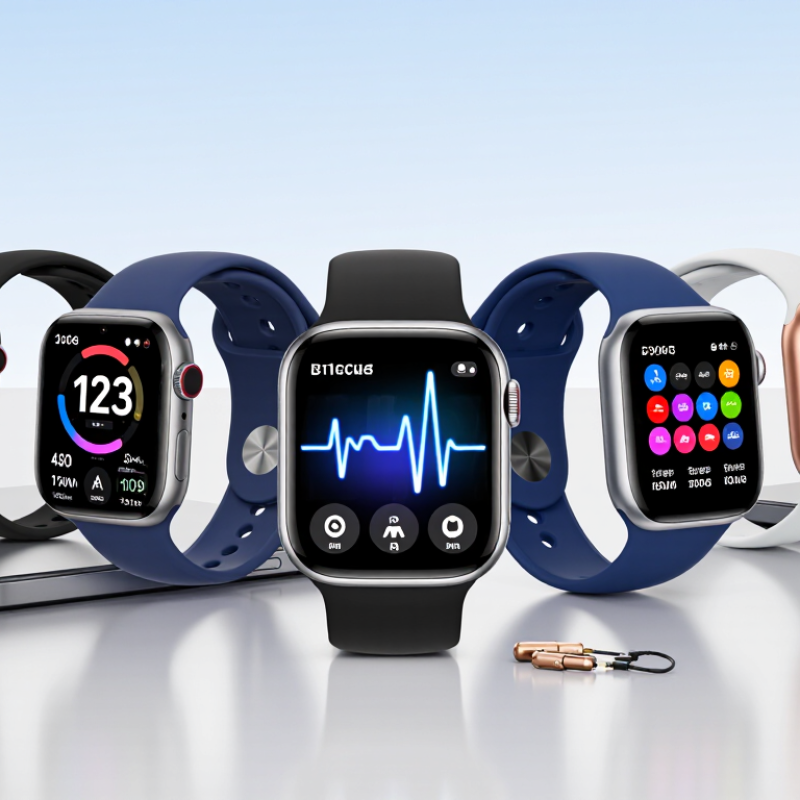
Bluetooth fitness smartwatch suppliers are entering a much larger connected-device market.
According to the Bluetooth Special Interest Group, Bluetooth device shipments reached 5.4 billion units in 2023. This figure covers many product categories, not only smartwatches. Still, it shows the scale of the wireless ecosystem supporting fitness wearables.
For 2026 sourcing, buyers should examine sensor accuracy, battery performance, Bluetooth stability, and software support.
A reliable supplier should provide test reports, production samples, and clear firmware update procedures. Ask how heart-rate readings perform during running, cycling, and poor skin contact.
Small details matter. A loose charging contact can ruin user trust.
Suppliers with strong engineering teams often offer better customization, including watch cases, display layouts, health dashboards, and packaging. However, customization can increase development time and quality risks.
I have seen attractive prototypes fail during repeated charging tests. That weakness deserves attention before a large order.
Buyers should also check factory capacity, inspection records, component traceability, and after-sales response times. The 5.4 billion shipment figure reflects broad Bluetooth adoption, but it does not guarantee every smartwatch supplier is dependable. Performance must be verified through samples, field testing, and honest communication.
The 2024 Counterpoint benchmark reported a 7% year-on-year decline in global smartwatch shipments. That figure changes how buyers should assess 2026 Bluetooth fitness smartwatch suppliers. Faster growth is no longer enough. Suppliers must show stable production, accurate health sensors, and dependable Bluetooth connections.
From practical sourcing reviews, the strongest suppliers usually provide detailed test records. These records should cover battery cycles, sweat exposure, step-count accuracy, and phone compatibility. Ask for samples from different production batches. One sample proves very little. A watch may perform well in a showroom but lose connection during outdoor training. Small details matter, such as readable screen brightness, secure strap materials, and charging contact durability.
Cost pressure is also visible. Some suppliers reduce packaging or simplify software support to protect margins. That can create hidden expenses later. Buyers should check firmware update policies, repair procedures, data protection controls, and delivery performance. These areas often reveal supplier reliability better than a polished product presentation.
The market decline deserves careful reflection. It may show weaker consumer demand, not just temporary inventory adjustment. However, fitness-focused models can still serve users who value sleep tracking, heart-rate monitoring, and everyday activity records. Suppliers with transparent testing, responsive engineering teams, and realistic production promises are better positioned for this cautious market. Mistakes still happen, even with experienced factories. The important question is how openly they identify and correct them.
Supplier-neutral procurement benchmark for evaluating Bluetooth fitness smartwatch manufacturing capabilities. Company and brand data are intentionally excluded.
| Benchmark Dimension | Verified Market or Technical Data | 2026 Supplier Evaluation Requirement | Recommended Evidence | Reference |
|---|---|---|---|---|
| Global smartwatch shipment trend | 2024 shipments declined 7% year over year. | Prioritize suppliers with flexible production capacity, lower minimum order quantities, and documented demand-planning processes. | Quarterly capacity plan, production flexibility statement, and historical order-adjustment record. | Counterpoint Research, 2024 global smartwatch shipment benchmark |
| Bluetooth connectivity | Bluetooth Low Energy is the standard low-power wireless technology used for smartwatch-to-phone communication. Bluetooth Core Specification 5.4 was released in 2023. | Require stable BLE implementation, configurable connection intervals, secure pairing, reconnection after signal loss, and support for commonly used GATT services. | Bluetooth qualification details, interoperability test report, RF test report, and Android/iOS connection logs. | Bluetooth SIG, Bluetooth Core Specification |
| Battery endurance | Battery life varies by display, sensors, GPS usage, notification frequency, and software configuration; no single industry-wide endurance value applies to all smartwatches. | Request test results under defined use cases instead of accepting an unspecified “long battery life” claim. | Standardized test matrix covering normal use, continuous heart-rate monitoring, exercise tracking, Bluetooth connection, and standby mode. | Supplier test protocol; conditions must be disclosed |
| Ingress protection | IP ratings are defined under IEC 60529. The first digit measures protection against solids and the second digit measures protection against water. | Specify the required IP level and test conditions. Do not treat an IP rating alone as proof of suitability for swimming or prolonged water exposure. | Accredited laboratory IP test report, production audit, gasket inspection records, and water-exposure limitations. | IEC 60529, Degrees of protection provided by enclosures |
| Health-data positioning | Heart rate, sleep, activity, and blood-oxygen features may be wellness functions and are not automatically medical devices. | Require accurate product labeling, region-specific regulatory review, and a clear separation between wellness metrics and medical claims. | Claims matrix, intended-use statement, regulatory assessment, and validation summary for each sensor feature. | Applicable regional medical-device and consumer-product rules |
| Sensor performance validation | Optical heart-rate accuracy is influenced by skin contact, motion, fit, skin characteristics, temperature, and sensor placement. | Compare performance across multiple activity types and user conditions rather than relying only on resting measurements. | Independent validation protocol covering rest, walking, running, cycling, loose fit, and varied user profiles. | Supplier validation data; independent testing recommended |
| Positioning and exercise tracking | GNSS performance depends on antenna design, satellite visibility, firmware, urban obstruction, and power-management settings. | Request route-accuracy and time-to-first-fix results under open-sky, urban, and intermittent-use conditions. | GNSS test routes, location logs, firmware version history, and power-consumption measurements. | Supplier engineering test records |
| Data security and privacy | Bluetooth pairing, mobile-app communication, cloud synchronization, and account access create separate security control points. | Require encrypted communication, secure firmware updates, access-control procedures, vulnerability reporting, and a defined data-retention policy. | Security architecture, penetration-test summary, update policy, privacy policy, and incident-response procedure. | Supplier security documentation; applicable privacy legislation |
| Application and firmware support | Smartwatch functionality depends on the watch firmware, companion application, mobile operating-system compatibility, and cloud services. | Evaluate documented release management, backward compatibility, issue-response times, and the ability to provide long-term security updates. | Firmware roadmap, supported-device matrix, defect-response SLA, update history, and software-development process. | Supplier software-support records |
| Quality management | Wearable products combine electronics, batteries, displays, sensors, mechanical seals, and software, requiring multidisciplinary quality controls. | Prefer suppliers with traceability from incoming materials through final inspection and shipment release. | Quality-system certificate, process-control plan, inspection criteria, corrective-action records, and batch traceability. | Supplier quality-system documentation |
| Battery and shipping compliance | Lithium-ion batteries are subject to transport, safety, labeling, and test requirements that vary by shipment method and destination. | Require complete battery documentation before mass production and export, including cell specifications and transport-test evidence. | UN 38.3 test summary, battery specification, safety data, transport documents, and charger compliance records. | UN Manual of Tests and Criteria; applicable transport regulations |
| Production-readiness scorecard | Market-wide shipment contraction increases the importance of cost control, supply continuity, and product differentiation. | Use a weighted review: quality 25%, connectivity and software 20%, sensor validation 20%, battery and safety 15%, capacity 10%, commercial flexibility 10%. | Completed technical questionnaire, sample-evaluation report, factory audit, pilot-run results, and total-cost analysis. | Procurement evaluation framework based on the 2024 market benchmark |
The 2026 supplier landscape is separating into three practical groups: consumer brands, OEM factories, and ODM design houses. Brands control positioning and user trust. OEMs manufacture proven hardware. ODMs provide ready platforms, firmware, apps, and industrial design. This distinction matters when comparing quotations. A low unit price may hide tooling fees, software charges, or minimum order quantities.
Demand remains substantial. IDC’s Worldwide Quarterly Wearable Device Tracker reported 611.5 million wearable shipments in 2023. Bluetooth SIG’s 2024 Market Update also projected annual Bluetooth device shipments could exceed seven billion by 2028. These figures support continued sourcing activity, but they do not guarantee smartwatch profitability. Buyers should verify heart-rate accuracy, battery testing, waterproof ratings, Bluetooth qualification, data security, and regional compliance before signing contracts. Ask for laboratory reports, not only presentation samples.
Supplier quality varies sharply. Some ODMs can deliver a working sample within weeks, yet struggle with firmware updates after launch. That is a common weakness. Experienced procurement teams should inspect production lines, review defect records, and test ten or more random units. Contract terms should define replacement rates, source-code access, cloud ownership, and support response times. Grand View Research continues to identify health monitoring and connected wearable functions as major market drivers, but sensor claims need independent validation. A polished dashboard is not clinical evidence. The best 2026 partner is therefore not simply the cheapest factory, but the supplier with measurable engineering discipline, transparent documentation, and dependable post-launch support.
For 2026 smartwatch sourcing, Bluetooth performance deserves more than a version number.
Bluetooth SIG’s 2024 Market Update forecasts 5.1 billion annual Bluetooth device shipments by 2028. Suppliers should document Bluetooth 5.x profiles, range tests, reconnection time, and battery impact. A stable connection matters during outdoor workouts. Not just in laboratories.
GPS quality depends on antenna design, chipset tuning, and environmental conditions.
GPS.gov reports civilian GPS accuracy of about seven meters under open-sky conditions. Urban buildings can reduce it sharply. Request track overlays, cold-start times, and distance-error results. Compare repeated runs, not one impressive sample.
5ATM should align with ISO 22810 testing, but it does not mean safe scuba diving. ECG requires clear electrode contact, signal-quality screening, and clinically designed validation. Heart-rate accuracy also changes during intervals, cold weather, tattoos, and loose strap placement. A 2024 review in Sensors reported meaningful variation across wrist-worn devices, especially during vigorous movement. Ask suppliers for mean absolute error, confidence intervals, participant numbers, and skin-tone representation. Marketing screenshots are weak evidence. Raw logs are better.
Supplier claims can still be incomplete.
I would test samples independently. That costs time. It prevents expensive assumptions. A technically mature supplier should provide firmware histories, calibration procedures, waterproofing reports, and failure-rate data. They should also explain what the watch cannot measure reliably. That honesty is often more valuable than another feature.
For 2026 sourcing, a Bluetooth fitness smartwatch supplier should pass a practical scorecard, not a glossy presentation.
Start with MOQ, because a low unit price means little if inventory sits for months. Record the exact MOQ for samples, pilot orders, and repeat production.
Ask whether customization changes the threshold. A supplier offering 100 units may require 1,000 units for a custom case. That difference affects cash flow immediately.
Good evidence matters.
Request current ISO 9001 certificates and verify the issuing body’s details. Review CE, FCC, and RoHS documents against the exact watch model and hardware revision.
Generic certificates create risk. Check test reports, declaration dates, factory addresses, and product identifiers.
For battery evaluation, inspect cell origin, rated capacity, protection circuitry, charging tests, and transport documents.
Ask for sample units before approving mass production. Measure standby time, charging temperature, Bluetooth stability, and heart-rate consistency. Results can vary.
Lead time should include component purchasing, assembly, testing, packaging, and shipment preparation. A supplier promising 15 days may exclude approval delays.
Use a written schedule with inspection gates and corrective actions. During audits, photograph labeling, battery storage conditions, and final inspection records.
I would score communication too; slow answers often predict slow problem-solving.
Still, the scorecard is imperfect. Certificates can expire, samples can be selected, and delivery estimates can change. Recheck critical evidence before each major order, especially after firmware or battery changes.
Global shipments fell 7% year over year. This may reflect weaker demand, not only temporary inventory changes. The market needs careful evaluation.
Check production stability, sensor accuracy, connection reliability, and delivery performance. Request records for battery cycles, sweat exposure, and step-count accuracy.
One sample proves very little. Request samples from different batches. Compare their screen brightness, straps, charging contacts, and connection stability.
Ask for range tests, reconnection times, supported profiles, and battery impact. Test connections outdoors, not only in a quiet laboratory.
Request track overlays, cold-start times, and distance-error results. Repeat tests in open areas and cities. Buildings can sharply reduce accuracy.
No. It generally supports water resistance under defined test conditions. It should not be treated as safe for scuba diving.
Request error measurements, confidence intervals, participant numbers, and skin-tone representation. Test loose straps, tattoos, cold weather, and vigorous movement.
Review firmware history, update policies, repair procedures, data controls, and failure rates. Polished presentations can hide expensive support problems.
Transparent testing and responsive engineers matter. Realistic production promises matter too. A mature supplier explains product limits openly. Mistakes still happen.
The 2026 Bluetooth Fitness Smartwatch supplier market is shaped by strong Bluetooth device adoption, despite a reported 7% year-over-year decline in global smartwatch shipments in 2024. This environment creates opportunities for established brands, OEMs, and ODMs that can offer reliable products, flexible customization, and consistent manufacturing capacity. Buyers should evaluate suppliers not only by product appearance and pricing, but also by technical performance and long-term support.
Key assessment areas include Bluetooth 5.x connectivity, GPS stability, 5ATM water resistance, ECG functionality, and heart-rate measurement accuracy. A practical supplier scorecard should also compare minimum order quantities, ISO 9001 quality systems, CE, FCC, and RoHS compliance, battery performance, production scalability, and lead times. Suppliers that balance dependable hardware, transparent certification, responsive communication, and efficient delivery will be better positioned to meet the diverse requirements of fitness, wellness, and connected-device markets in 2026.